About LUNGOCOSTA
A journey along the coast, born from a lifetime on trains
LungoCosta is an independent project about a different way of travelling through Italy: following the coast mainly by regional train, and letting the railway become part of the journey rather than simply a way to reach the next destination.
It grew out of travel experience, railway research and one simple idea: give you enough information to understand the route, follow it as it is, or change it and make it your own.
THE STORY BEHIND THE JOURNEY
Before LungoCosta,
there were the trains
I’m Andrea — a photographer, web designer and IT consultant, and the person behind LungoCosta. I live in Florence and work wherever the job takes me.
My father worked on the railway. My parents didn’t own a car, so in our family the train was not something we took only when we went on holiday: it was simply how we got around.
I grew up around station waiting rooms and platforms, night-train couchettes and local trains and watching the landscape change outside the window. That habit stayed with me: I kept travelling by train around Italy, across Europe and further afield, and I still use trains and public transport every day, for both work and pleasure.
The train has remained the most natural way for me to get around. When I don’t have to drive, the time becomes mine again: I can read, work, think, or simply look out of the window. And perhaps it was all those hours spent watching the world go by that, almost as a joke, eventually gave me the idea for LungoCosta.
If you would like to see the work I do outside LungoCosta,
you can find it at andrea-moretti.it. →
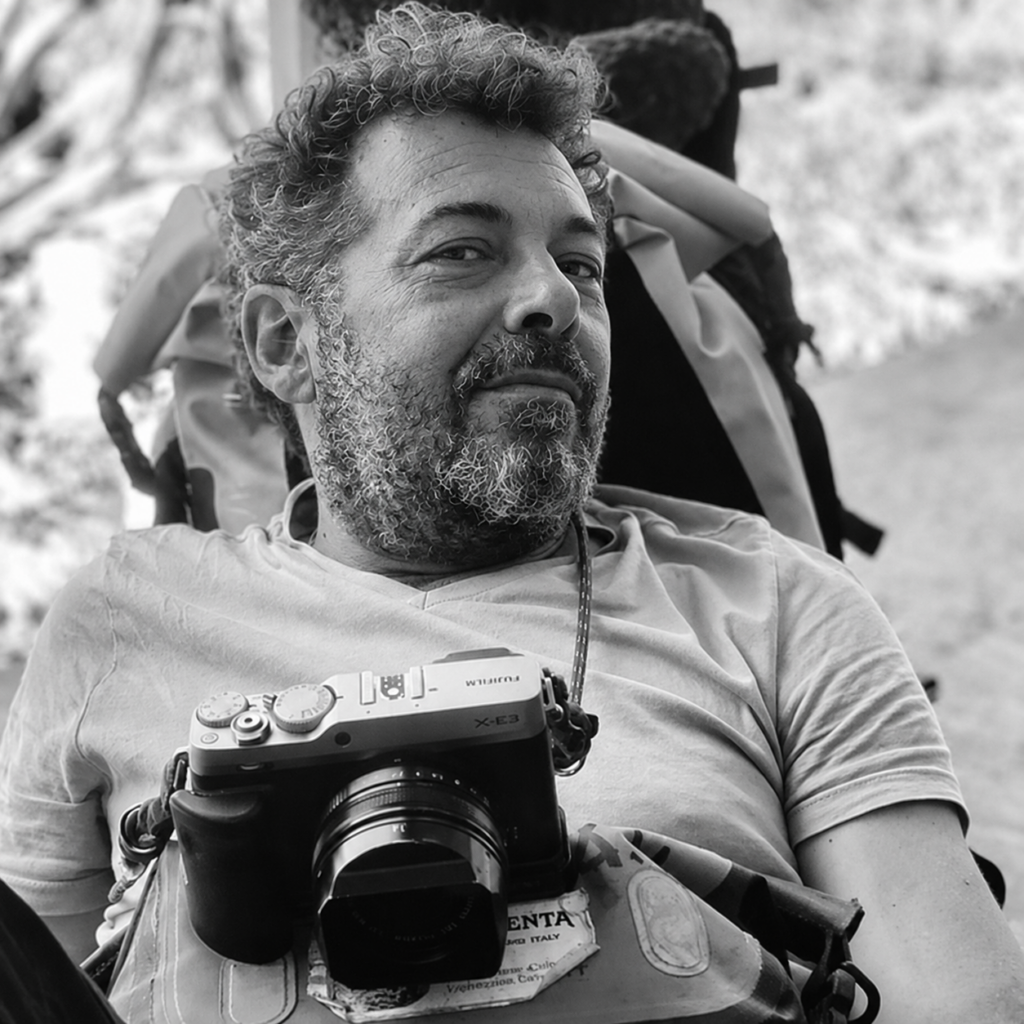
Andrea Moretti, founder of LungoCosta and photographer. Trains are part of both my travels and my everyday life.
THE IDEA
How far can you follow the shape
of Italy by rail?
For years I watched the Italian coast appear and disappear outside train windows, always in fragments.
Liguria. The Tyrrhenian coast. Stretches of the Adriatic. The Ionian coast. Different lines, different journeys, different moments.
Italy is a peninsula and, along a surprisingly continuous part of its perimeter, the railway runs close to the coast. From there came a natural thought: in Italy, it should be possible to follow almost the whole of the country’s natural boundary with the sea by train.
For many kilometres, the railway quite literally runs lungocosta — along the coast.
That led to a question:
How far can you follow the shape of Italy by rail?
I wasn’t looking for the fastest way to cross the country. That already exists.
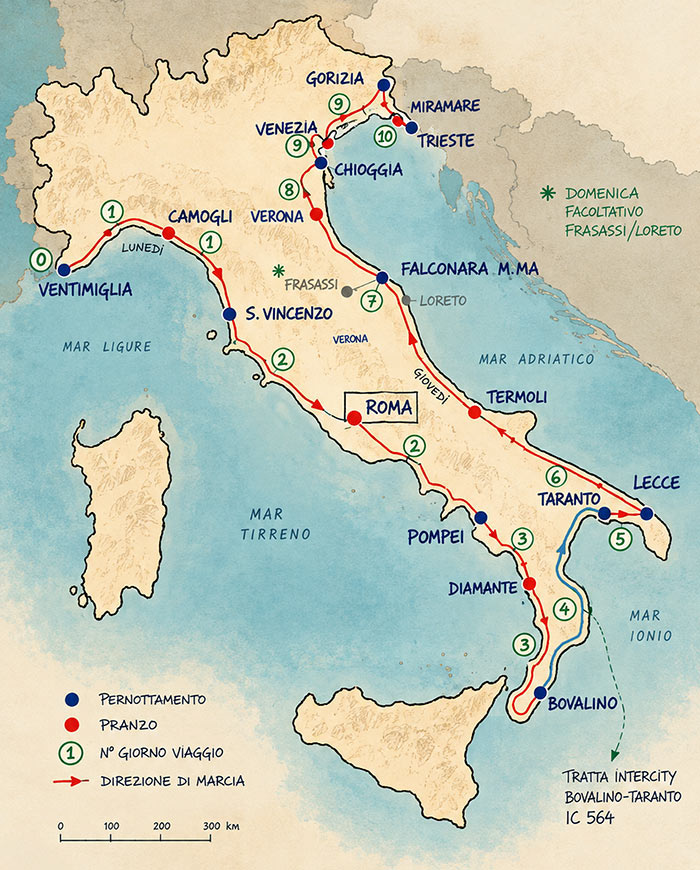
I wanted to know whether the pieces of railway I had been seeing for years could become one continuous journey: starting at the French border, travelling down the Tyrrhenian side, around the southern tip of the peninsula, then back up along the Ionian and Adriatic coasts to Trieste.
A journey where the train is not simply a way to get somewhere, but keeps revealing the country as you move through it. And where it makes sense to get off along the way: for lunch, for a few hours, for a night — and then continue.
LungoCosta 0 is the first answer to that question.
Following the borders
From Ventimiglia to Trieste, border to border, following Italy’s natural edge along the sea.
Mostly Regional
Regional trains, practical stops and real rail connections.
A clear framework
Ten days as a starting point, not a fixed formula.
Made to be changed
Follow it as it is, or change the pace, the stops and the length of the journey.
THE METHOD
The route first. The stops second.
Years of travelling by train have taught me that a leg that looks simple on paper can feel very different when you actually travel it.
Timetables matter, of course, but so do the length of the connections, the station where you change, the time spent on board, the time you arrive and what you can realistically do before you need to move on again.
That experience is what shapes the way I build LungoCosta. I study the railway network section by section, compare timetables, check connections and work out how much travelling actually makes sense in a single day.
The route comes first. The stops come second.
Only then do I look for the right place for lunch, a longer stop or an overnight stay. That is why LungoCosta stops do not begin with a generic list of Italian destinations.
Some are famous. Others are simply the right place to get off, eat, sleep and continue the next morning.
They have to make sense within the journey, not just be interesting places in isolation.
PLANNING A REAL JOURNEY
Enough information to start. Enough freedom to change it.
Travelling across Italy by regional train does not mean everything will always go exactly as planned. Timetables change. Engineering works can disrupt a line. A train can run late and a connection can be missed.
LungoCosta is not about removing every uncertainty or planning every minute of the journey for you. It is about reducing uncertainty enough for you to travel independently.
Knowing which line to follow. Where to change. Which connections need more attention. Where there is an alternative. What to check again before you leave.And, above all, understanding the route well enough to change it yourself.
AN INDEPENDENT PROJECT
Built so you can use it without me
LungoCosta is an independent project and, today, I run every part of it myself.
Routes, writing, photography, railway research and editorial decisions all come through me. That helps me keep the project coherent and return to any piece of information when it needs to be checked or updated.
But for LungoCosta, being independent means something else too:
The information I publish is not a teaser for a paid service.
The route, timetables, Train Guide and practical tools are designed to give you enough information to plan and make the journey independently.
If something on the site is not clear, ask me: explaining what I publish is part of the project.
If, instead, you would like me to work specifically on your journey — your dates, the time you have available, your pace, comfort level or interests — that is a separate personalised planning service.
Independence first.
Personal help, only if you want it.
Travel independently
Information and tools to set off on your own.
Ask if something isn't clear
Questions about the content are welcome.
Personalised help, only if you want it
To work together on your journey.
WHY LUNGOCOSTA
A different way to cross Italy
At the heart of LungoCosta is a simple belief: travelling across Italy does not have to mean moving from one famous place to the next.
Sometimes what stays with you is an almost empty regional train, a station where you had never planned to stop, lunch in a place whose name you did not know before, or the sea suddenly appearing again outside the window.
A journey can be slow without being vague.
Practical without becoming ordinary.
Carefully planned without losing the freedom to change your mind.
I don’t sell Italy.
I share a different way to cross it —
one stage at a time, by regional train
Andrea Moretti
Founder, LungoCosta
FROM THE PROJECT TO THE JOURNEY
See where it all began
LungoCosta 0 is the first complete journey built around this method: a real route from Ventimiglia to Trieste, designed to be followed as it is, adapted along the way or used as a starting point for building your own journey.

FREE LUNGOCOSTA MINI-GUIDE
A practical guide to keep with you, even offline
Get the free PDF with the LungoCosta 0 map, the 10-day journey at a glance, essential train notes and a practical pre-departure checklist. Save it on your phone or print it, so the key information stays with you throughout the journey — even when you’re offline.
Get the free guide
Download the guide, no sign-up needed.
Or enter your email and I’ll send it to your inbox.
If you like, you can also join the monthly LungoCosta newsletter.