THE ITINERARY
Lungocosta Zero
From France to the edge of the Balkans, around Italy in 10 days
A real journey along the Italian coast, designed to work exactly as it is,
and to be changed almost anywhere along the way.
You can follow it from beginning to end. Or use it to understand the route, take it apart and build your own.
10 DAYS · MOSTLY REGIONAL TRAINS · VENTIMIGLIA → TRIESTE · NO CAR REQUIRED
How far around the shape of Italy can you follow the railway?
Italy is a peninsula, and for a surprisingly continuous part of its coastline the railway runs close to the sea.
So I wondered whether it could be used to travel around the country:
starting at the French border, following the Tyrrhenian coast south, rounding the toe of the peninsula, then heading north along the Ionian and Adriatic coasts to Italy’s eastern border.
I already knew that travelling across Italy by train was not the problem. If you wanted to, much of this route could be covered in just a few days. But getting from Ventimiglia to Trieste quickly was not what interested me.
I wanted to understand something else: could that continuity of railway become a journey?
Not simply a long sequence of trains, but a route where the landscape keeps changing outside the window and where, every so often, it makes sense to get off, eat, walk, look around and then continue.
That question became LungoCosta 0.
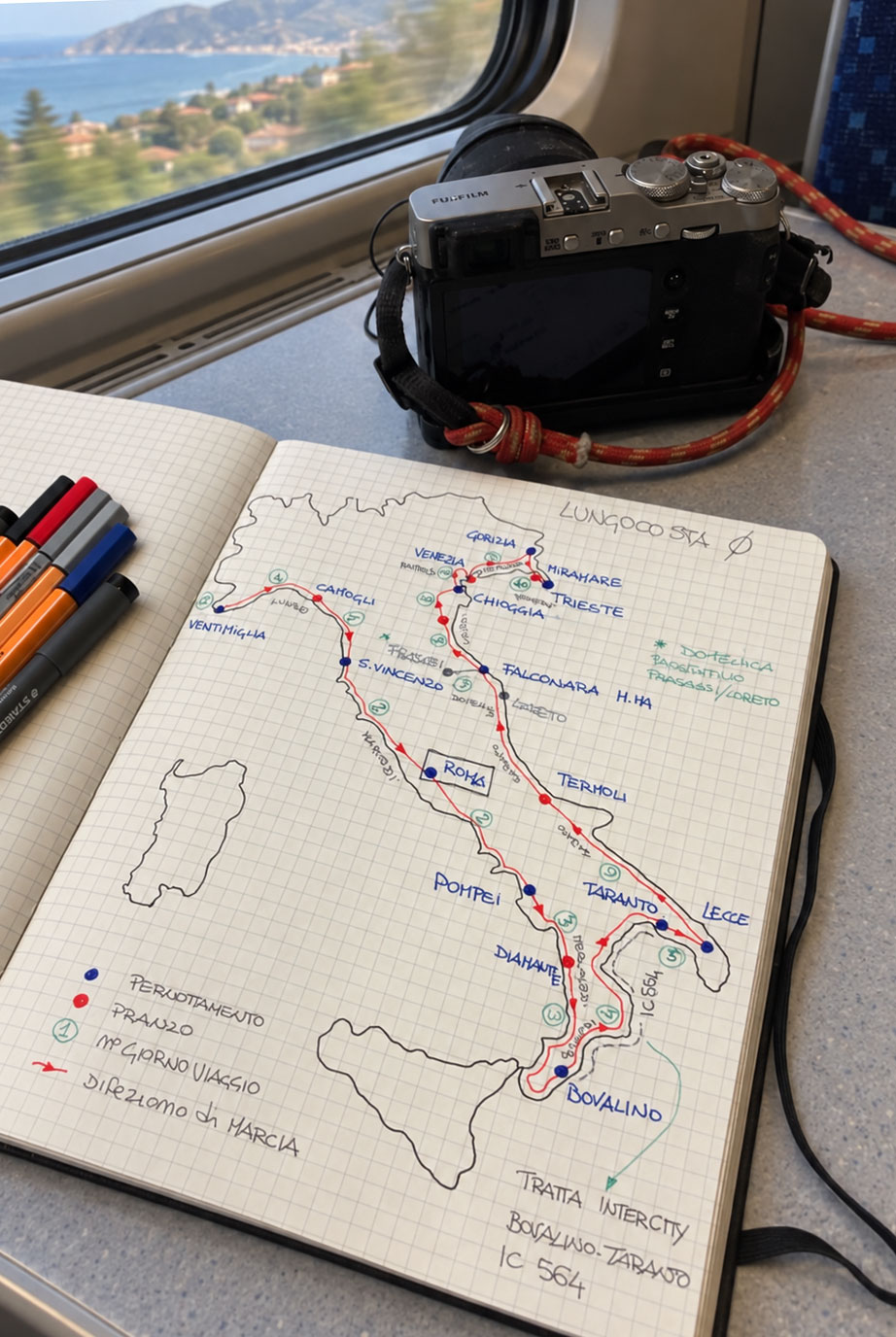
AT A GLANCE
Four ideas that explain the journey
The essentials, in four points.
A quick taste of how LungoCosta works, so you can understand the idea at a glance.
Fast enough to cross Italy. Slow enough to get off the train.
Zero does not mean provisional, it is a "toolbox": this is where everything else begins
Choose the route, then choose the stops.
The sea is the thread of the journey, not a reason to travel only in summer
THE PACE
Fast enough to cross Italy. Slow enough to get off the train.
LungoCosta 0 could be travelled much faster.
If the only goal were to get from Ventimiglia to Trieste, you would not need ten days. Even following much of the coast, the journey could be compressed into something closer to a small railway challenge. That could be interesting. But that would be a different story. I wanted the time spent on the train to carry the same weight as the time spent off it, and that is why ten days felt like a good balance: enough movement to really feel the continuity of the Italian coast, but enough time on the ground to interrupt the journey and let it change.
Lunch by the sea. A few hours in Pompeii. San Vitale in Ravenna. A walk through Chioggia. Venice. Gorizia before the final stretch to Trieste — although not every stop needs to become a full day of sightseeing.
Sometimes two or three hours are enough. You get off the train, eat something, walk down to the sea or across part of a town, then continue. By the time you are back on board, the landscape is already different.
That is exactly the alternation I was looking for.
The train is not simply there to connect the stops. It is part of the stops.
Ten days also have a practical advantage: they fit naturally with two consecutive five-day Italia in Tour passes and can sit comfortably inside a two-week holiday, leaving time to reach Ventimiglia and travel home from Trieste. But ten is not a sacred number.
– Have more time? Slow down.
– Have less? Travel only part of the route.
It is not the ideal duration for everyone. It is simply the pace LungoCosta 0 was built around.
Two practical notes
Travel light.
Ten days of trains, platforms, stairs, changes and short stops are much easier with luggage you can comfortably handle on your own without thinking too much about it.
Already travelling with Interrail or Eurail?
You can use them along LungoCosta too. Coverage and reservations depend on the train service: the full comparison is in the dedicated guide →
“A way of travelling that takes you a long way, while still leaving time for the things that matter.”
THE STARTING POINT
LungoCosta Zero is not a provisional version
LungoCosta Zero is the first major route in the project: a concrete way to show that another kind of journey is possible — slower, more aware, and closer to the places you travel through.
Zero does not mean draft.
LungoCosta 0 will always remain LungoCosta 0 because it is the journey the whole project starts from: a complete, verifiable version of the route, built from Ventimiglia to Trieste. If you want, you can simply follow it.
You already have a sequence of days, stops, connections and a practical way to travel along the Italian coast.
But there is another reason LungoCosta 0 exists.
It has to show you that the route can be taken apart.
You can change a train without changing the journey.
You can sleep at the previous station or the next one. Skip a stop. Add a detour. Travel only the Tyrrhenian coast or only the Adriatic coast. You can turn a three-hour stop into three days.
And if you arrive somewhere and want to stay for a week, stay for a week.
You have not lost LungoCosta. When you are ready to continue, you return to the route and it is still there. That is the difference between an itinerary you have to execute and a structure you can use. LungoCosta 0 wants to be the second kind.
Follow it, and you are making this journey.
Start changing it, and you are building your own.
“Zero is the starting point. And already a destination.”
ROUTE FIRST
The stops are not a ranking of the most beautiful places in Italy
I did not start LungoCosta by making a list of the towns and cities where I wanted to stop. I started with the railway.
The question was:
what continuity of railway actually lets you follow the shape of Italy without using a car?
Only after finding that structure did I start dividing it into days. And the network sets a different pace from coast to coast. Some sections have frequent, fast and relatively straightforward trains. Others require more changes, more time, or a more careful choice of where to end the day.
The Adriatic, for example, lets you cover a lot of distance fairly easily. Crossing the south, rounding Calabria and heading back up towards Puglia requires a different kind of planning.
So I first looked for days that worked on the railway. Then I looked at what was along that route. Sometimes a stop was almost inevitable: Pompeii, Ravenna, Venice. Sometimes the choice came from the sea. Sometimes from the food. Sometimes a place was simply the right point to get off in the evening and start again the next morning.
This matters because LungoCosta is not trying to tell you which are the ten most beautiful places in Italy.
It wants to show you how to turn a railway network into a journey.
And that is also what makes the method reusable. Once you understand the structure, you can change the stops without having to start again from scratch.
Route first. Stops second.
The stops can change.
The logic of the journey remains.
“The route gives the journey its structure. The stops give it meaning.”
SEASONS
The sea is the thread of the journey, not a reason to travel only in summer
LungoCosta does not belong to a single season.
The sea is not just the scenery that accompanies the journey: it draws much of Italy’s border and shapes the route itself. The season changes a great deal about how you travel it.
In summer you get long days, coastal towns in full swing and more chances to stop at the beach. But you also get more heat, more people, and trains that can be very busy on some lines.
Spring and early autumn often offer a different balance: easier temperatures, fewer crowds, and still enough life along the coast to keep alternating trains, walks and time outdoors.
Out of season, the journey does not disappear. It simply becomes a different journey: quieter, with shorter days and coastal towns that may run on different rhythms and offer different services.
There is also a second calendar to consider: the railway one.
Italian timetables change periodically, and scheduled engineering works or seasonal adjustments can alter some connections.
That is why LungoCosta always distinguishes between the route, which remains, and the timetables, which need to be checked before you travel. So there is no compulsory season.
There is simply the period that best suits the journey you want to make.
The sea remains the thread. You choose the pace.
When to go, in detail: seasons, railway timetables and crowds →
“Same line, different seasons, a thousand possible journeys.”
Ten days from border to border
The timeline here is intentionally concise. Timetables, train numbers, changes, alternatives and backup plans are all in The Journey.
Changing the itinerary does not break the journey
LungoCosta 0 is built around railway continuity, not a compulsory sequence of reservations.
That is what makes it easy to change.
You can leave on another day. Take a later train. Sleep one town earlier or one town further along. Stay for three days instead of one night. Remove a detour or add a new one.
Have an extra week? Slow down. Only have a few days? Travel part of the coast.
You do not have to “rejoin” LungoCosta 0 after changing it. As long as you keep using the line and following the principle behind the journey, you are still travelling LungoCosta.
“The route is mine.
The journey is yours.”
Useful sections for following the coast
You are not just searching for a destination. You are choosing a line.
Link opens the official Trenitalia website in a new window: https://www.trenitalia.com/it.html
Do not just search for the destination. Search the line.
There is one important thing to understand when building a journey like this.
If you ask a railway journey planner for a route between two distant cities, it will normally look for the most efficient solution.
But the most efficient solution is not necessarily the one that follows the coast. For LungoCosta, it is often better to break the journey into shorter sections that belong to the same railway corridor.
That is the method I used to build LungoCosta 0, and you can use it too.
A concrete example
If you search directly for Naples → Catanzaro, a journey planner may prefer the faster route via Lamezia Terme. If you want to continue around the Calabrian coast, you need to guide the search through the railway corridors you actually want it to follow.
When I can, I prefer to sit down for lunch
The stops are not there to make too many hours on a train bearable.
I actually like being on trains.
I built the journey around the way I travel: slowly, wanting to see and enjoy the places I am passing through, not simply get past them.
That is why the pace always alternates train and ground — three hours on a train, three hours on the ground, another four on a train — because, for me, the journey is exactly this mixture of travelling and arriving, not one serving the other.
It is not a fixed rule: trains run throughout the day, so you can make any stop longer or shorter as you prefer.
When those hours on the ground fall at the usual Italian lunchtime, for me that means sitting down at a table. Eating, not simply “refuelling” — a pleasure on a par with a sunset or the cool sea in summer.
It might be a beach, a rock by the sea, a town, a suburb or even something architecturally questionable.
It is still Italy.
The route remains. The trains may change.
LungoCosta 0 is not tied to one particular Monday or one particular combination of trains.
But a railway timetable is not permanent.
The published timetables are there to show that each day can actually be travelled and to give you a complete, ready-to-use solution.
LungoCosta is checked again when new timetable editions are published. Before every journey, however, always verify your trains through the official channels.
The line remains. The minutes may change.
Practical note
The timetables published on LungoCosta are a verified basis for planning, not a guarantee that a particular service will operate. Scheduled engineering works, seasonal changes, strikes and service alterations can change a travel day.
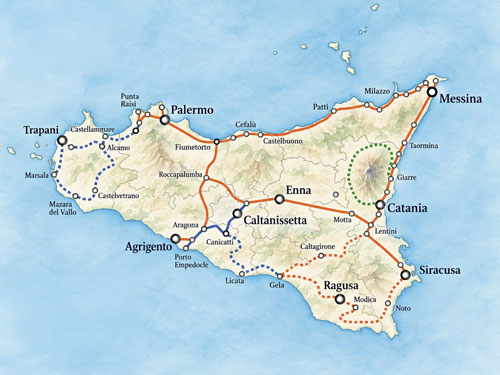
What if you want to add Sicily?
Sicily is LungoCosta’s most ambitious extension. It requires much more complex railway planning, but it also adds one of the most unusual experiences in Italian rail travel: some Intercity trains are carried onto a ferry to cross the Strait of Messina.
It is not part of LungoCosta 0, but it is exactly the kind of extension the method allows you to build.
If you do not need to ask me anything, LungoCosta has worked
I want you to have enough information to understand the journey, prepare for it and travel it independently.
The route, timetables, alternatives, railway explanations and practical guide are all there for that reason.
If you can travel LungoCosta 0 without needing to ask me anything, then the site has done a good job of explaining the journey.
If something about LungoCosta 0 is still unclear, ask me: I built it, and I would rather improve an explanation than leave a traveller with a doubt.
Your journey can start here and become something completely different
You can build the whole thing yourself.
But if you would rather have some help, I can also work with you professionally to adapt LungoCosta 0 or design a different itinerary.
We can start with the time you have, the places you want to see, the pace you prefer, food, photography, or simply one question: “These are the days I have. How would you do it?”
Help is available. It is not required.
Travel-planning and itinerary-design consultancy. Bookings and travel-agency services are not currently included.

FREE LUNGOCOSTA MINI-GUIDE
A practical guide to keep with you, even offline
Get the free PDF with the LungoCosta 0 map, the 10-day journey at a glance, essential train notes and a practical pre-departure checklist. Save it on your phone or print it, so the key information stays with you throughout the journey — even when you’re offline.
Get the free guide
Download the guide, no sign-up needed.
Or enter your email and I’ll send it to your inbox.
If you like, you can also join the monthly LungoCosta newsletter.